
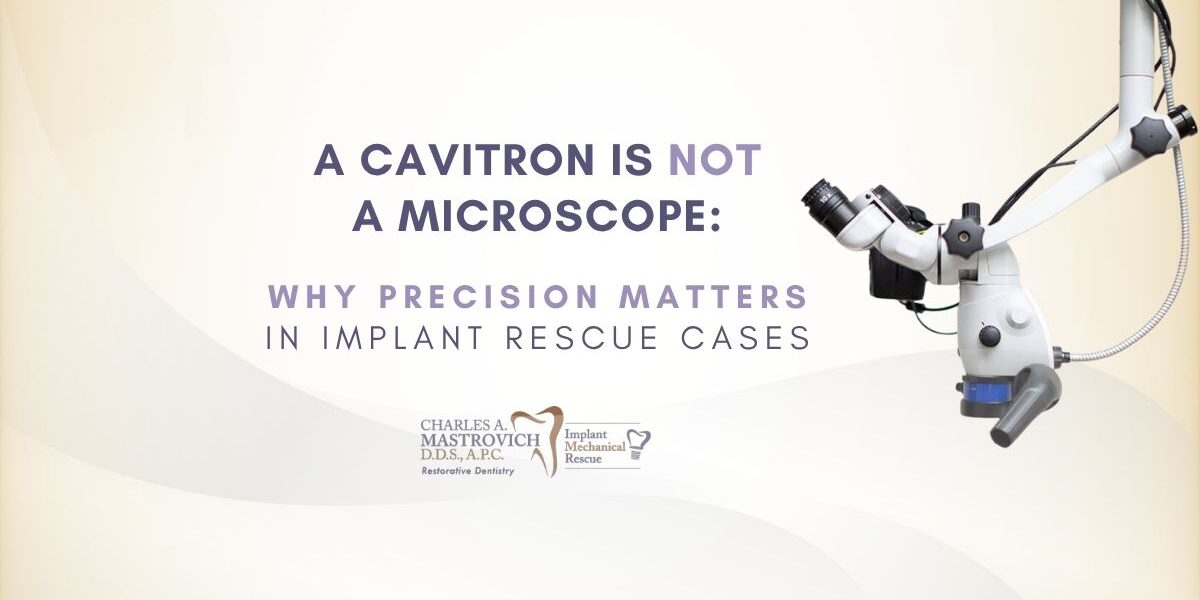
In today’s fast-paced clinical environment, it’s easy to reach for familiar tools like a Cavitron or other ultrasonic devices when presented with an implant complication. They’re accessible, efficient, and widely used in hygiene and general dentistry. But when it comes to implant mechanical rescue—especially fractured screw retrieval—this mindset is creating a growing problem: clinicians are substituting ultrasonics for precision. And that’s a mistake.
Understanding What Ultrasonics Are (and Aren’t)
Ultrasonic devices like Cavitron units are designed to remove plaque and calculus using high-frequency vibration and water irrigation. (Cavitron) Their strength lies in debridement—not in a delicate, high-precision surgical procedure. While they can be adapted for various clinical uses, they are inherently limited in control, visibility, and specificity.
That limitation becomes critical when working inside the confined, intricate geometry of a dental implant.
The Real-World Consequences
Clinical evidence and case observations continue to show a troubling pattern: failed ultrasonic attempts leading to irreversible implant damage. In documented testing, using a Cavitron at moderate power for just 2.5 minutes caused significant internal destruction of a titanium implant—without successfully retrieving the screw fragment. (Implant Mechanical Rescue) The instrument indiscriminately altered any surface it contacted, erasing the distinction between the implant and the screw fragment.
Even more concerning, the water spray and lack of magnification made precise targeting nearly impossible. What clinicians intend as a conservative approach often results in rounded, unrecognizable internal damage—making future retrieval exponentially more difficult, or even impossible.
These aren’t isolated incidents. Referrals continue to come in, sometimes daily, with the same story: prior ultrasonic attempts, followed by complications.
Why a Microscope Changes Everything
Implant mechanical rescue is not just about removing a fragment—it’s about doing so without compromising the implant. That requires controlled, concentric, and highly visualized techniques.
Research and clinical reports consistently emphasize the importance of magnification. The use of a dental operating microscope allows clinicians to combine ultrasonic or mechanical techniques with enhanced visualization, dramatically improving precision and minimizing damage. (PubMed)
In fact, successful retrieval protocols rely on guided access, controlled instrumentation, and the ability to clearly differentiate between materials at a microscopic level. Without that visibility, clinicians are essentially working blind.
The Bottom Line
Let’s be clear: ultrasonics are not inherently bad tools. They are incredibly effective—when used for their intended purpose. But they are not a substitute for magnification, precision, or proper implant rescue protocols. Using a Cavitron in place of a microscope is like using a jackhammer for microsurgery.
A Better Approach
When faced with a fractured screw or abutment:
- Avoid uncontrolled ultrasonic use inside the implant
- Prioritize visualization with a dental microscope
- Use guided, precision, concentric techniques designed to preserve implant integrity
- Refer early if the case exceeds your available tools or experience Implant mechanical rescue is a discipline—not a workaround.
Final Thought
The message is simple, but critical: Cavitron/Ultrasonics is NOT a replacement for a microscope.
With more cases presenting complications from prior ultrasonic attempts, the profession must shift away from convenience and back toward precision. Because in implant dentistry, what you can’t see can destroy what you’re trying to save.
Contact Dr. Mastrovich and the Mastrovich Dental Team for more information on our Implant Mechanical Rescue services.