March 2026
Another Example of Multiple, Early TiBase Abutment Fractures When In Single Tooth Molar Applications
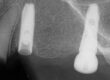
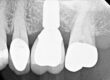
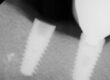
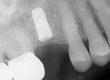
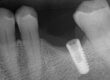
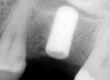
The patient presented for retrieval of two fractured TiBase abutments from two 4.8 Straumann BL RC implants in the #s 29 and 30 sites. Both implants were placed in October 2021 and subsequently restored on 04.13.22. Both TiBase abutments and restorations were provided by Glidewell. #30 fractured first and #29 fractured second, about one month later, per the patient report.
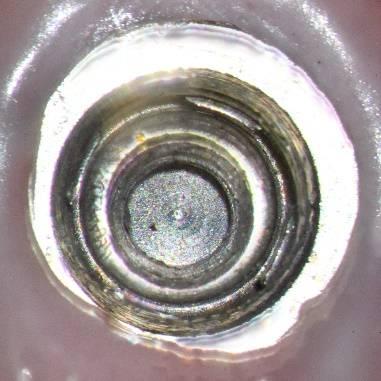
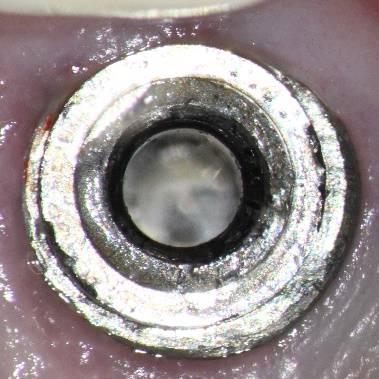
Following routine abutment screw retrieval with microscope visualization and guidance, both abutment fragments were “wobbled” out of the implants using only a precision fitting through bore tool which was worked in a circular motion to release each abutment. Both implants were cleaned and photographed. This is when an implant scar in #30 was noted in the 9:00 position. Historically, #30 had a previous abutment failure, which was not mentioned in the referral history, but reported by the patient at his appointment. This scar was probably created by rotary free hand drilling in the process of recovering the abutment fragment. The location of this defect was fortunate, in that it was below the cross fit indexing feature and above the majority of the implant threads, in a nonfunctional transitional titanium shelf in the implant. This defect does not have any connection with the current failure, nor will it decrease the implant connection stability or prognosis going forward. Following the internal implant cleaning, both implants were examined and found to be free of any other defects at the 25x level of inspection.
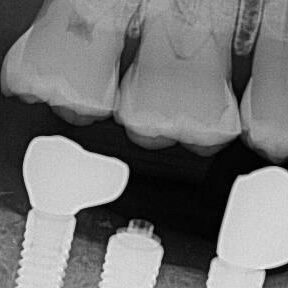
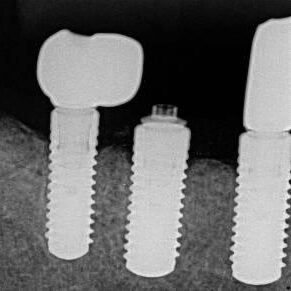
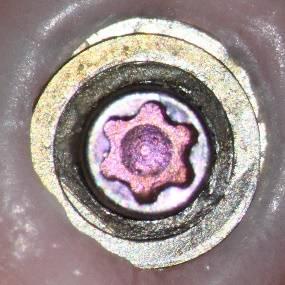
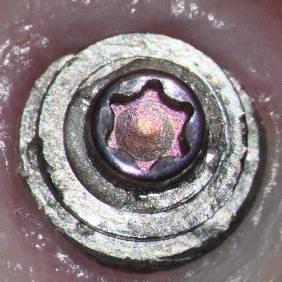
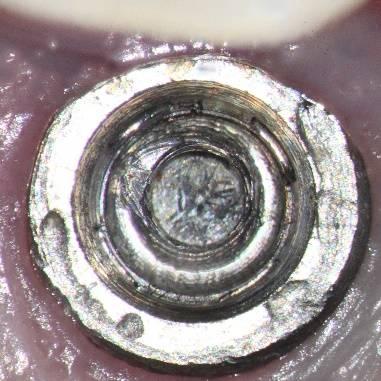
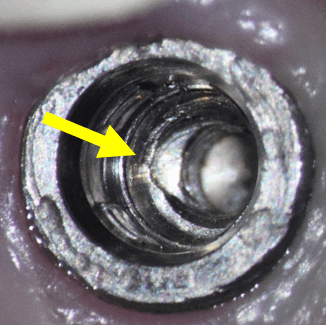
The question then presents as to why there have been three abutment fractures in less than 4 years in function? The answer resides, to a great extent, in the design of the TiBase abutment. In general, I see many cases in which abutments have fractured, mostly when the abutment fragment cannot be retrieved from the implant, as in this case. When the abutment to implant connection is stable the next area vulerable to fracture occures around the top of the implant. This cross sectional area can be very limited and thus more prone to fracture. The design issue of the connection and size limitation is often the result of a design trend in which a complete line of implant diameters share a common connection size. This becomes more critical when a narrow diameter connection is used in a larger diameter implant. The larger diameter implant is often used in a single tooth molar application where occlusal forces are 4 times greater that in anterior areas and a larger molar restoration can introduce larger torsional loading forces, (force x leverage arm). Additionally, implant location can multiply these forces even more, depending on position of the implant relative to the occlusal table. In this case where Straumann 4.8 BL RC implants were used, the cross sectional area of the abutment at the implant top is 6.11sq.mm and is limited by the size of the connection minus the area of the through bore for the abutment screw. As the 4.8 BL RC shares a common connection with the 4.1 Bl RC, the 4.8 ends up with the a thicker implant wall but the same sized abutment connection. While 6.11sq.mm is respectable and larger than many, I still have recovered many BL RC fractured abutments when used in single tooth molar applications. Unfortunately, when a TiBase abutment is used the fracture zone shifts to the base of the vertical cylinder, as this becomes the weakest cross section. Both of these recovered abutment fragments fractured in this area and both measured the same at 2.91sq.mm. This area is pitifully small when compared to the size of a custom BL RC abutment at 6.11sq.mm. This is a 52.37% decrease in surface area.
A thorough review of additional information and case studies on this topic is available here.
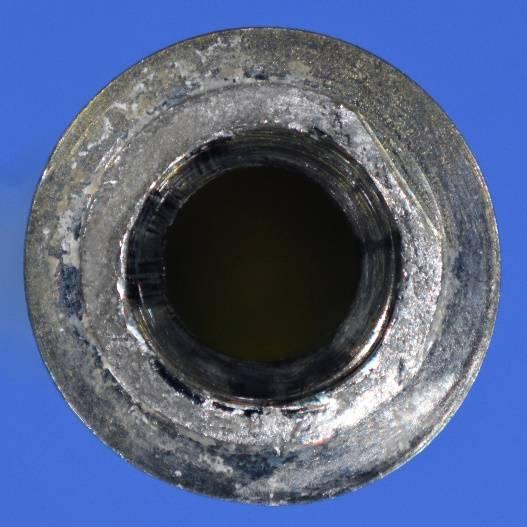
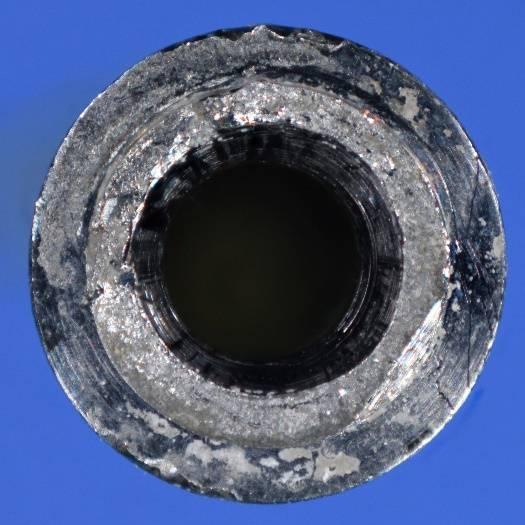
Clearly, a move away from TiBase is advisable. Incidentally, Straumann Variobase is their name for TiBase and should be avoided in this application as well. We have recovered numerous Variobase abutments with fracture zones roughly equivalent to the ones recovered here. The question then arises, in this case will individual custom abutments offer enough pillar strength to avoid future fractures? Maybe, maybe not. There is no way of calculating the actual forces applied and how they will be used. Other than adjusting the contact areas to even out the mesial to distal spacing, over what is present on the bitewing radiograph, splinting could significantly decrease mesial to distal torsional loading. In the least, a thorough discussion should be presented prior to proceeding. Lastly, when considering abutments, I would highly recommend using Straumann OEM custom abutments vs. other non-OEM manufacturers. It will reduce one variable in the event of future failure. Straumann AXS offers this service, one that I have used in the past.
For additional information regarding these procedures, there are additional case studies posted on our website.
Charlie Mastrovich, DDS